Dust, Crackle, and Cool: How the Record Player Became the Coolest Thing in Your Kid Sister's Apartment
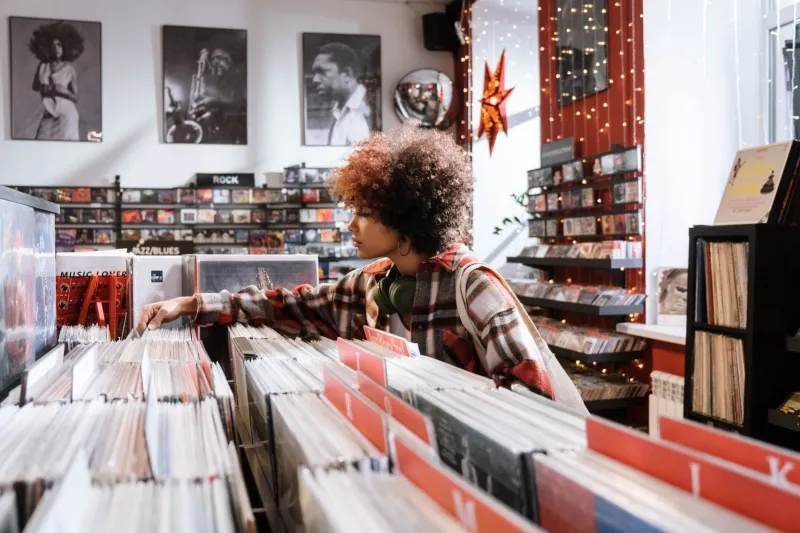
There's a particular kind of satisfaction in watching someone who grew up on Spotify carefully lower a needle onto a spinning record for the first time. Their eyes go wide. They tilt their head. And then, almost involuntarily, they smile — not at the music exactly, but at the process of getting to it. That little ritual, that warm crackle before the first note hits, is apparently worth more to a generation raised on infinite, frictionless playlists than anyone in the music industry predicted.
Vinyl record sales in the United States have now outpaced CD sales for two consecutive years, according to the Recording Industry Association of America. That's not a typo. The format that was ceremonially buried sometime around 1992 is outselling the format that replaced it. And the people driving those numbers aren't aging baby boomers getting dewy-eyed over their old Springsteen pressings — it's millennials and Gen Z, buying turntables on Amazon and flipping through dollar bins at record fairs in Brooklyn, Nashville, Portland, and pretty much everywhere else with a decent farmers market.
So what's actually going on here?
The Streaming Hangover Is Real
Let's be honest about something. Streaming is extraordinary and also, somehow, deeply unsatisfying. You can listen to virtually every song ever recorded for about the price of two fancy coffees a month, which should feel like a miracle and mostly just feels like standing in front of a packed refrigerator with nothing to eat.
There's a psychological term for this — paradox of choice — and it applies to music consumption with almost comedic precision. When everything is available all the time, nothing feels particularly special. Albums blur into playlists, playlists blur into algorithms, and somewhere in there the actual listening gets lost.
Record collectors will tell you, sometimes at great length and with a level of enthusiasm that can be mildly alarming, that vinyl forces you to pay attention. You pick a record. You commit. You flip it over at the halfway point. You read the liner notes because they're right there in your hands. You can't skip to the good part without physically getting up.
That's not a bug, according to the people buying records in 2024. That's the entire point.
It's Not Just Nostalgia — But It's Also Definitely Nostalgia
Record shops across the country have noticed something interesting about their younger customers: many of them started with their parents' collections. A box of records discovered in a garage. A turntable pulled out of storage. An old copy of Rumours or Purple Rain or Kind of Blue that suddenly had a face and a weight and a sleeve with actual photographs on it.
There's an intimacy to inheriting someone's record collection that you simply cannot replicate by being handed a Spotify login. Those records carry a kind of archaeology — a track list someone chose, a sleeve someone handled, maybe a name written in marker on the inner sleeve. Millennials, a generation famously anxious about authenticity and connection, have latched onto this with considerable enthusiasm.
But to write it off as pure nostalgia is to miss something. Many of the most dedicated young collectors are buying records of music that came out after the format was supposedly obsolete. New pressings of current artists. Limited editions. Colored vinyl. Taylor Swift's catalog in about seventeen different configurations. The format isn't just a time machine — it's become a statement about how you want to engage with culture.
The Record Shop as Third Place
Walk into an independent record store on a Saturday afternoon and you'll find something that feels almost radical by modern retail standards: people just hanging out. Talking about music. Asking for recommendations. Arguing, gently, about which Joni Mitchell album is the correct entry point for a newcomer. (It's Blue, and this is not up for debate.)
Record shops have become, in many American cities, one of the last genuinely casual public spaces where you can linger without being nudged toward a purchase or a reservation. They occupy the same cultural niche as the old corner barbershop or the neighborhood diner — places where the transaction is almost secondary to the experience of being there.
Independent record stores have actually been growing in number over the past decade, reversing what once looked like an extinction-level decline. Record Store Day, the annual April celebration that turns vinyl shopping into something approaching a community festival, now draws lines around the block in cities that didn't even have a record shop ten years ago.
Sound Quality: The Audiophile Argument (Simplified for Normal People)
Here's where things get a little technical, but stick with us. The debate about whether vinyl actually sounds better than digital audio is genuinely complicated and has been fought across a thousand internet forums with the intensity usually reserved for presidential elections.
What's less debatable is that vinyl sounds different. The analog warmth, the gentle compression, the way a well-pressed record reproduces the natural resonance of a room — these qualities are real and measurable, even if whether they're preferable comes down to personal taste. Many listeners describe the experience of a good record on a decent turntable as feeling more present, more like being in the room with the musicians.
For younger listeners who've grown up hearing music primarily through earbuds and Bluetooth speakers, that quality can come as a genuine revelation. It's not that streaming sounds bad. It's that a record, played on a real turntable through real speakers, sounds alive in a way that a compressed audio file simply doesn't.
The Identity Piece
Let's not pretend there isn't a social dimension to all of this, because of course there is. A record collection displayed on a shelf communicates something about the owner in a way that a Spotify library — invisible, private, slightly embarrassing in its algorithmic honesty — never quite can. Your records are a curated self-portrait. They invite conversation. They start arguments. They tell people something about who you are and, perhaps more importantly, who you'd like to be.
This is not new. People have always used their cultural consumption as identity signaling. But in an era when so much of our media diet is invisible, algorithmic, and vaguely shameful, the physical record collection has become a way to put a stake in the ground. To say: I chose these. Deliberately. With my actual hands.
What Alfred Would Have Made of All This
There's something quietly delightful about the fact that the format which once felt hopelessly analog and obsolete has become, of all things, a symbol of intentionality for the most digitally saturated generation in history. The wheel turns, the needle drops, and somehow the crackle of a forty-year-old pressing sounds like the future.
If there's a lesson here — and we're not saying there is, because lessons are for people with more patience than we have — it might be that authenticity has a way of circling back around. That the things which require a little effort, a little care, a little getting-up-to-flip-the-record tend to mean more than the things that don't.
Or maybe people just really like Fleetwood Mac. Both things can be true.